
BoursoBank is a wholly-owned subsidiary of Société Générale, since the acquisition in 2002 of the company that would become Boursorama Banque. The affiliation is not cosmetic: it structures the balance sheet, the refinancing model, and the banking license under which customer accounts operate. Understanding who is behind BoursoBank means reading the strategy of the Société Générale group itself.
Amortization of acquisition costs: the accounting lever that BoursoBank activates
The profitability of an online bank largely hinges on the customer acquisition cost. BoursoBank has long accounted for acquisition and loyalty bonuses immediately as expenses, which mechanically weighed down current results during years of strong growth.
The group announced a change in method: these bonuses will now be amortized over seven years. This accounting choice smooths the charge over time and improves the readability of the income statement, without altering actual cash flow. For analysts, this signal indicates that Société Générale views BoursoBank as a long-term asset, not as a temporary cost center.
This treatment is consistent with the recent conquest trajectory. The group expects sufficient volume for the seven-year amortization to be absorbed by the recurring revenues generated by the installed base.
To learn more about Buzzorama, the analysis of this accounting mechanism sheds light on the real strength of the BoursoBank model beyond mere marketing display.
Société Générale strategy and BoursoBank’s positioning within the group

BoursoBank is not an isolated product. Société Générale’s strategic plan organizes an explicit complementarity between BoursoBank and the agency network. The idea is documented: BoursoBank attracts the general public sensitive to low fees, while the physical network refocuses on a wealthier clientele and professional customers with higher added value.
This segmentation has concrete consequences for the product offering. BoursoBank now promotes savings and wealth management, not just the free current account that built its reputation. The plan includes an expansion into margin products (life insurance, retirement savings plan, mortgage), which alters the revenue profile of the subsidiary.
The model relies on two main pillars:
- A nearly zero-cost bank account to attract volume, with a range of cards (Welcome, Ultim, Metal) covering different spending profiles
- Low-fee savings and insurance products, positioned to attract cost-sensitive clients
The question of reliability, often raised by prospects, finds its answer in this architecture: BoursoBank benefits from deposit guarantees just like any licensed bank in France, and its backing by Société Générale gives it access to the group’s equity for refinancing.
From Boursorama to BoursoBank: what the rebranding reveals
The transition from Boursorama Banque to BoursoBank in 2023 is not just a rebranding. It marks a break from the original identity of a stock market and financial information portal. At its inception, the company offered neither current accounts nor bank cards. The offering has been built in successive layers, eventually covering the classic triptych of retail banking: payments, savings, credit.
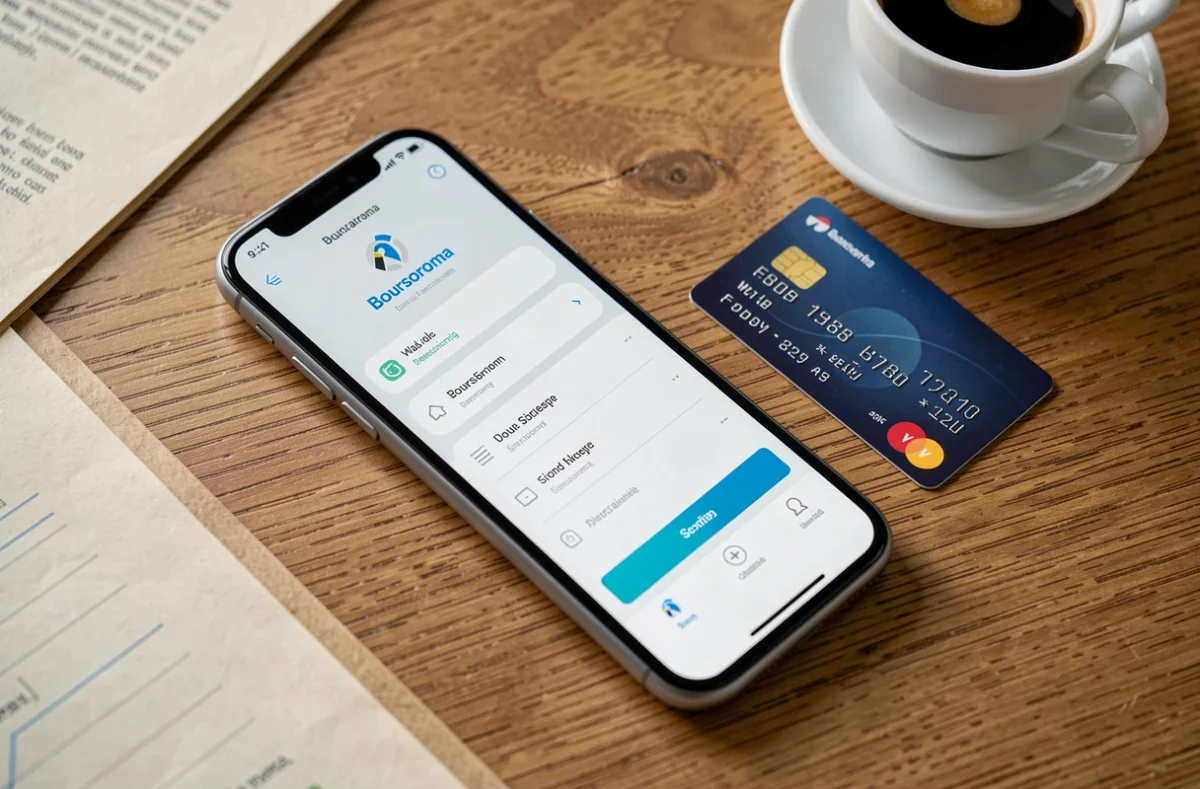
The name BoursoBank deliberately removes the reference to the stock market to assert a positioning of online general banking. It is a brand choice aligned with the goal of massive conquest: the target customer is no longer the individual trader of the 2000s, but a user looking for a primary bank with low fees.
This repositioning also explains the investment in mobile features. The logic is that of a French banking super-app, not an online broker linked to an account.
Online banking BoursoBank: the limits to know before subscribing
The absence of a branch network remains the main friction point. Customer service operates exclusively remotely. For complex operations (inheritance, professional financing, wealth management beyond standardized products), the model shows its limits compared to a network bank.
Mortgage lending at BoursoBank follows a fully digitized process, which suits simple cases but can slow down atypical arrangements. Granting conditions and processing times vary, and the lack of a dedicated physical contact remains a barrier for some borrowers.
Another point: the free bank card is subject to usage or income conditions depending on the chosen range. The Welcome card is accessible without income conditions, but the Ultim and Metal cards require either a minimum number of monthly transactions or an income threshold.
- Welcome: free without income conditions, basic features
- Ultim: free under conditions, aimed at travelers with reduced fees abroad
- Metal: premium card with extended services, positioned in the high-end segment
BoursoBank positions itself as the cheapest bank for about fifteen years according to the annual ranking it claims. This status relies on very low average annual banking fees, but it assumes primarily digital usage and a strong autonomy of the customer in managing their accounts.
The solidity of BoursoBank is not in question on a prudential level. Its future depends on Société Générale’s ability to transform the volume of clients into recurring revenues, through savings, insurance, and credit, without degrading the promise of low fees that built the brand.